Tender Monuments—Sacred Ordinary Revisited
Article Sidebar
Main Article Content
Abstract
I grew up understanding love through actions, through food. For Samoans in Aotearoa, visiting someone’s house means bringing something to share. No one leaves hungry. At family dinners, children are served first, their plates loaded, as a gesture of care. We collect kai moana together, we prepare food together, and we cook together even when the ingredients come in a Salvation Army box. Despite displacement, these rituals continue in the New Zealand context, where traditional language, clothing and ceremony are sometimes absent, transferred from traditional kitchens to plastic trays and foil wraps. Food is one of our strongest living ties to cultural identity. I’ve seen it in my Thai flatmate, in my Māori whānau and in many diasporic communities. Everyday practices quietly hold people together. My art emerges from a space where Indigenous and non-Indigenous worldviews are in constant dialogue. It is a space shaped by the principles of Te Ao Māori. the persistence of Māori activism and the responsibilities that come with inhabiting this whenua. Because this place is unsettled, active and contested, I, as a base line, have the freedom to create in ways that feel both anchored and exploratory—a freedom I acknowledge as a privilege. In many parts of the world, political thought that challenges the status quo is not only discouraged but actively suppressed. The ability to question, reflect and speak through creative practice is not something I take for granted. It’s about recognising the layered context I live in, where Te Tiriti o Waitangi offers an ongoing framework for negotiation and responsibility, but where my values as an artist are also grounded in simple, inherited acts of love, sharing and survival.
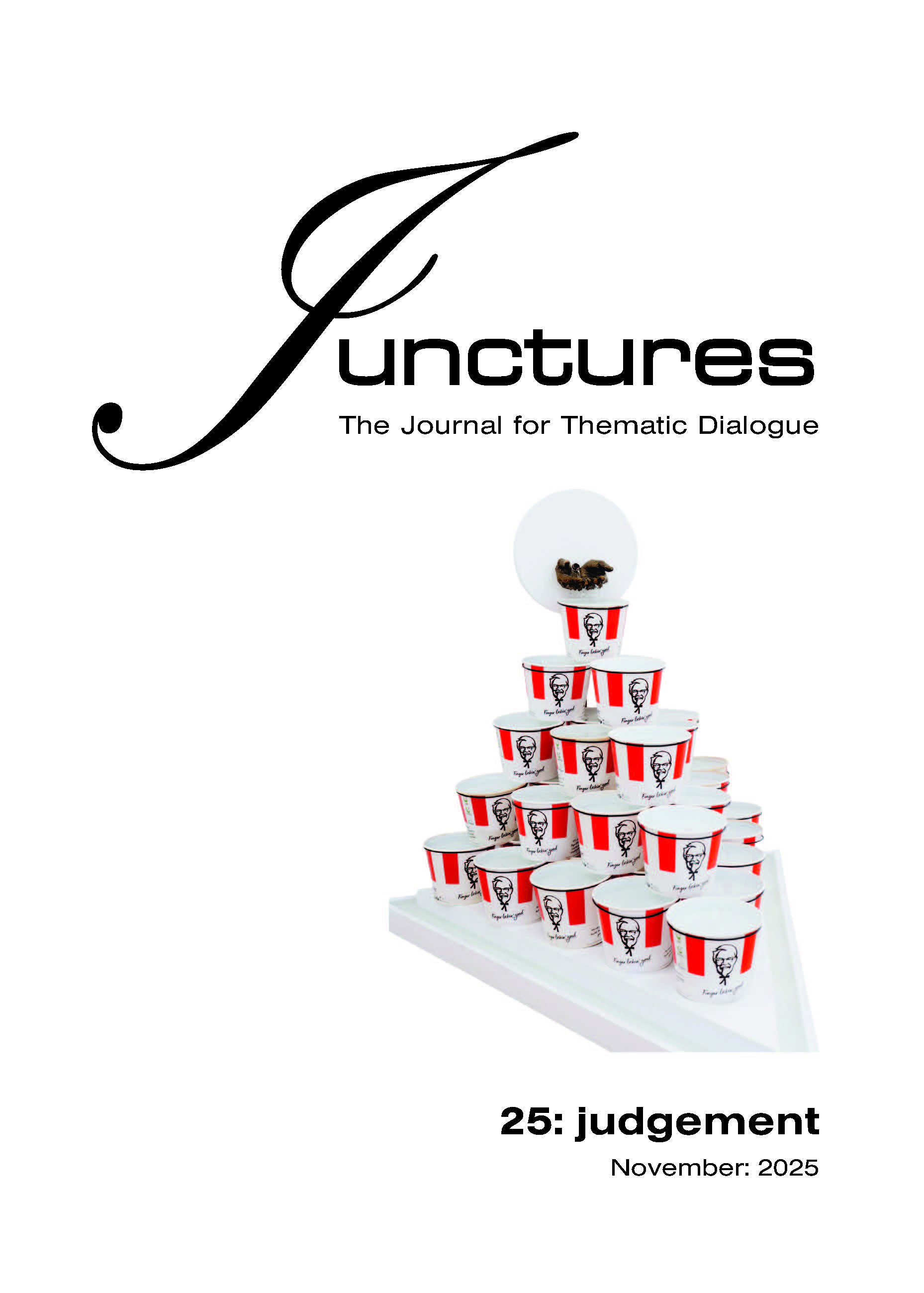
This article is a reflection on my installation at the Dunedin School of Art in November 2024. Taking the form of a personal, autoethnographic narrative, it counters a reading of the work’s various packaged-food-related objects that draws only from critical theory. That intellectual reading, I suggest, is liable to result in the judgement of a marginalised cultural group as passive consumers of inauthentic mass-produced commodities. I argue instead for embracing the contradictions the items embody, whereby they are equally signs of disconnection and connection for Samoan New Zealand families.
Article Details

This work is licensed under a Creative Commons Attribution-NonCommercial-NoDerivatives 4.0 International License.
Authors should note that in the spirit of open access to research Junctures is published under a New Zealand cc-by-nc-nd licence.
This licence is the most stringent cc-by licence currently available that means that people are free to read and redistribute the article but only with full acknowledgement of the author and the source. Although this licence does allow sharing of research, it does not allow any forms of commercial distribution. For more on cc licencing please see: http://www.creativecommons.org.nz/licences_explained__1 If you require your work to be published under a different licence please contact the Junctures Editorial Assistant.